
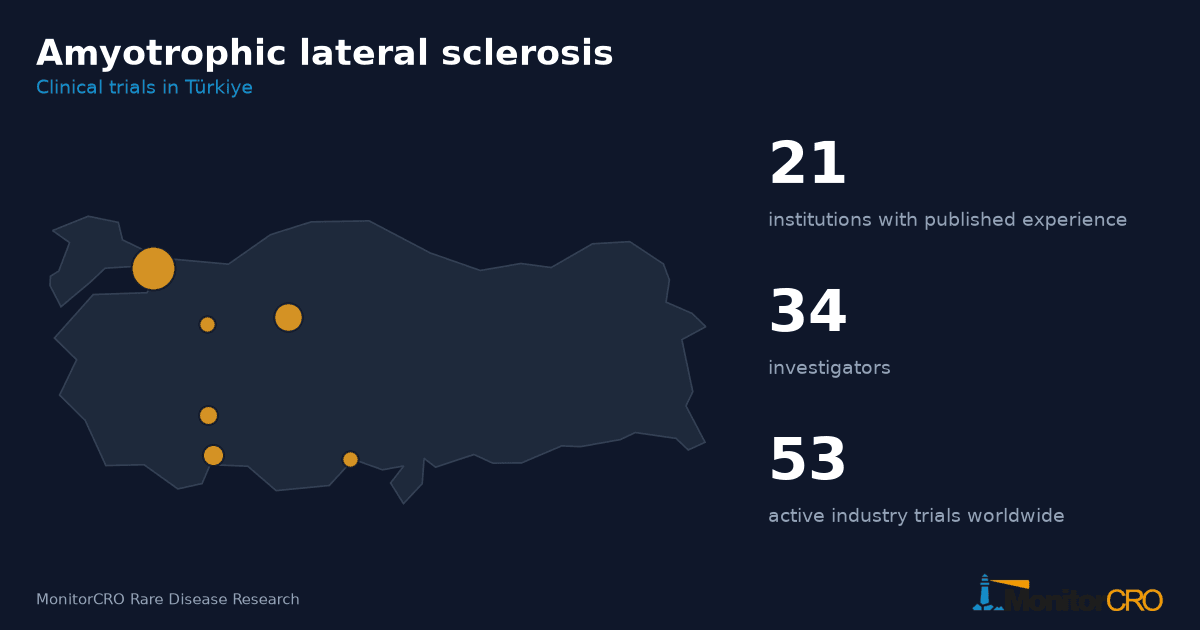
Amyotrophic lateral sclerosis (ALS) affects an estimated 4,000 people in Türkiye at any time, with more than a thousand new diagnoses a year. Twenty-one institutions in six cities have published on the disease or run registered studies, yet no industry-sponsored ALS trial has opened a Turkish site so far. For a sponsor planning the next phase, that combination of concentrated patients and an unused site network is unusual.
Registry and literature data as of 2026-09-24 · Published 2026-10-01
~4,000
estimated living patients in Türkiye
21
institutions with published ALS experience
34
investigators publishing since 2016
0
industry ALS trials with a Turkish site
ALS at a glance
ALS (ORPHA:803) is a progressive motor neuron disease. Worldwide it occurs in 2 to 5 per 100,000 people; 90 to 95 percent of cases are sporadic and symptoms usually begin in the late fifties or early sixties. The only widely reimbursed disease-modifying drug remains riluzole, which leaves a large unmet need and explains why more than a hundred industry sponsors have entered the field.
Two population studies give Türkiye its own numbers. In the Thrace region (2006 to 2010) the standardised incidence was 1.9 per 100,000 per year and the point prevalence 7.3 per 100,000, with a mean age at diagnosis of 57. In Antalya (2016 to 2018) point prevalence rose from 3.7 to 5.4 per 100,000 as case finding improved, with an incidence of 1.2 to 1.4 per 100,000. Both studies conclude that Turkish ALS looks like European ALS, not Asian ALS, which matters for protocols written around European natural history data.
The landscape in Türkiye
Applied to a population of about 85 million, those rates translate to roughly 4,000 living patients and 1,000 to 1,600 new diagnoses every year. Diagnosis and follow-up concentrate in the neuromuscular units of university and training hospitals: our screen of PubMed and the trial registries found 21 institutions and 34 investigators with ALS publications since 2016, across İstanbul, Ankara, Antalya, Isparta, Eskişehir and Mersin. İstanbul and Ankara together account for two thirds of that output.
The Thrace study measured a mean delay of 12 months from symptom onset to diagnosis, similar to Western Europe, and both Turkish studies used the revised El Escorial criteria. Electromyography, spirometry and multidisciplinary ALS clinics are standard in the referral centres. Riluzole is licensed and reimbursed, so a riluzole background is the norm for add-on designs. A national patient association is active and supports information and referral.
Why Türkiye for the next ALS study
The global picture is crowded: 119 industry sponsors have run 222 Phase 1 to 3 ALS studies, 53 of them active today and 40 of those started in 2024 or later. Most active studies still recruit in a single country, and sites in Western Europe and North America are shared between several programmes. Türkiye is different. None of the 222 industry studies has included a Turkish site, so the eligible population at the referral centres is not split across competing protocols.
Add to that a single national payer that concentrates rare disease patients in a small number of large hospitals, a single regulatory application to TİTCK with a parallel ethics review, and investigators who already publish in the international ALS journals. For a Phase 2 that needs to enrol quickly, or a Phase 3 that needs a country with no recruitment competition, Türkiye is worth a feasibility look.
How MonitorCRO opens Türkiye
MonitorCRO has run clinical trials in Türkiye since 1999 and acts as legal representative for international sponsors before TİTCK, so no local entity is needed. We prepare and file the single regulatory and ethics application, contract the centres, handle the import permit for the investigational product and monitor the sites on our own Helios EDC. The names of the ALS centres and investigators behind the numbers above are shared during feasibility, with their consent.
Questions sponsors ask
How many ALS patients could realistically be screened in Türkiye?
With roughly 4,000 living patients and the majority followed at a handful of university neuromuscular units, a well chosen set of four to six centres typically sees several hundred patients a year between them. We size this per protocol in the feasibility snapshot.
Is riluzole available and reimbursed in Türkiye?
Yes. Riluzole is licensed and reimbursed under the national insurance scheme, so add-on designs with a riluzole background fit routine practice.
Do Turkish ALS centres accept an English protocol and eCRF?
Yes. Study documents can stay in English. The informed consent form, patient-facing materials and source records are in Turkish, and MonitorCRO provides the certified translations.
Can Turkish sites be added to a Phase 3 that is already running?
Yes. Adding Türkiye is a new country application to TİTCK with the current protocol version. MonitorCRO acts as legal representative and runs submission, contracting and import in parallel.
Planning a study in this disease?
Tell us the indication, phase and timeline. We reply within two working days with a first view of centres, patient access and a start-up timeline for Türkiye.
Discuss your studySources
- MedlinePlus Genetics: Amyotrophic lateral sclerosis
- Orphanet: Amyotrophic lateral sclerosis (ORPHA:803)
- Turgut N et al. An epidemiologic investigation of ALS in Thrace, Turkey, 2006-2010. Amyotroph Lateral Scler Frontotemporal Degener 2019
- Uysal H et al. ALS in Antalya, Turkey. A prospective study, 2016-2018. Amyotroph Lateral Scler Frontotemporal Degener 2021
- MonitorCRO screen of ClinicalTrials.gov (industry Phase 1 to 3) and PubMed (Türkiye affiliations, 2016 onwards), September 2026
MonitorCRO Rare Disease Research