
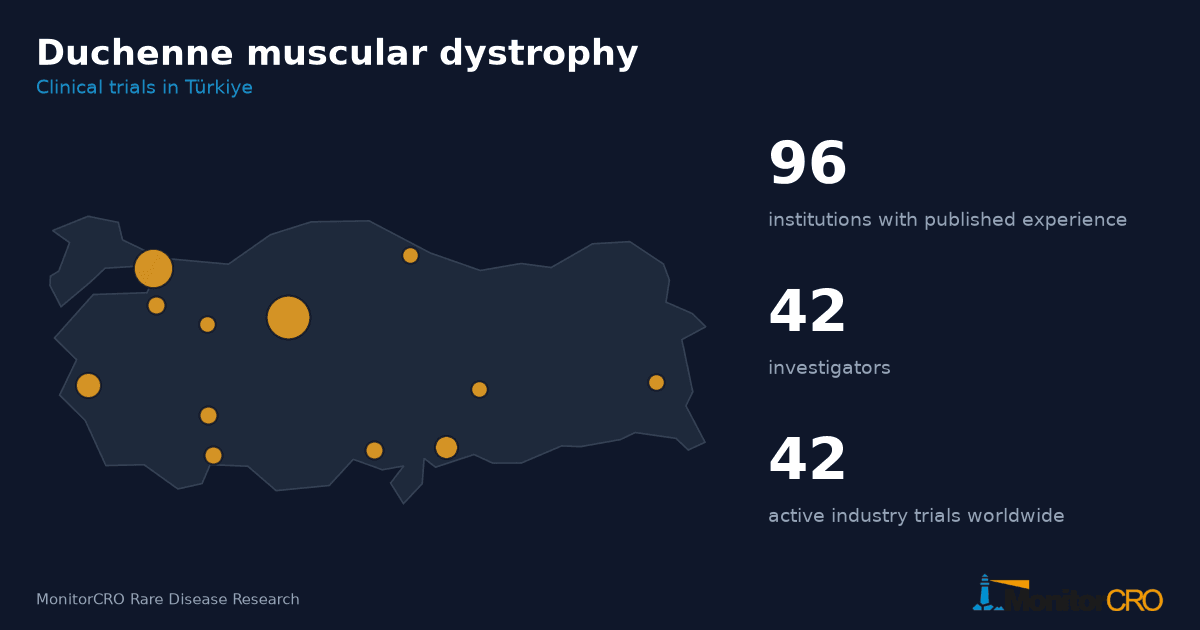
Duchenne muscular dystrophy (DMD) is diagnosed in more than a hundred boys a year in Türkiye, and the country already has one of the deeper DMD trial networks outside Western Europe: 96 sites in 24 cities with registered study or publication experience, 42 investigators publishing since 2016, and 17 industry-sponsored DMD trials that have run at Turkish sites. For a sponsor entering the next phase, Türkiye combines a large paediatric population with centres that have done this before.
Registry and literature data as of 2026-09-24 · Published 2026-10-01
100+
estimated new diagnoses a year in Türkiye
96
sites with DMD trial or publication experience
42
investigators publishing since 2016
17
industry DMD trials that used Turkish sites
Duchenne at a glance
DMD (ORPHA:98896) is an X-linked recessive dystrophinopathy. Duchenne and Becker muscular dystrophy together affect 1 in 3,500 to 5,000 newborn males worldwide; in the Duchenne form weakness appears in early childhood, boys are usually wheelchair-dependent by adolescence, and cardiac and respiratory involvement follow. Corticosteroids remain the standard of care, and exon-skipping, gene therapy and anti-fibrotic approaches drive a crowded pipeline: 49 industry sponsors have run 164 Phase 1 to 3 DMD studies, 42 of them active today and 25 started in 2024 or later.
The landscape in Türkiye
Türkiye records close to a million births a year, so the global incidence implies 100 to 140 newly affected boys annually and a living DMD population in the low thousands. Care is organised around paediatric neurology departments in university and city hospitals, with cardiology and pulmonology follow-up in the same institutions. Genetic confirmation by MLPA and sequencing is reimbursed, and recent Turkish cohorts describe the national variant spectrum and cascade screening of families.
Trial experience is broad. Our screen of the registries and PubMed found 96 sites across 24 cities, led by Ankara and İstanbul and followed by İzmir and Gaziantep, with 42 investigators publishing on DMD since 2016. Seventeen industry-sponsored DMD trials have used Turkish sites and five are still active, so paediatric neurology teams here already run six-minute walk tests, North Star assessments and the safety monitoring that DMD protocols demand. National muscle disease patient associations are active and support families through diagnosis and follow-up.
Why Türkiye for the next DMD study
Active DMD studies now span a median of three to four countries each, and the established European and North American sites are heavily booked. Turkish centres offer large paediatric catchments, a single national payer that keeps families at the same hospital for years, and investigators who have already delivered data into global DMD programmes. Ambulatory and non-ambulatory cohorts can both be recruited, and long-term extension studies are easier to retain when families do not change hospitals.
Paediatric consent is well defined: parents give written informed consent and children give age-appropriate assent under TİTCK's clinical trial regulation, with ethics committees experienced in paediatric protocols. Sponsors who have run DMD studies in Eastern Europe will find the site set-up, timelines and data quality comparable.
How MonitorCRO opens Türkiye
MonitorCRO has run clinical trials in Türkiye since 1999 and acts as legal representative for international sponsors before TİTCK, so no local entity is needed. We prepare and file the single regulatory and ethics application, contract the centres, handle the import permit for the investigational product and monitor the sites on our own Helios EDC. The names of the DMD centres and investigators behind the numbers above are shared during feasibility, with their consent.
Questions sponsors ask
How are paediatric consent and assent handled in Türkiye?
Parents or legal guardians give written informed consent, and children give age-appropriate assent, both in Turkish, following TİTCK's clinical trial regulation. MonitorCRO prepares the certified translations and the age-banded assent forms.
Are corticosteroids the standard background therapy in Turkish DMD care?
Yes. Corticosteroid treatment is routine at the paediatric neurology referral centres, so protocols that require a stable steroid regimen match local practice.
Do Turkish sites have experience with DMD functional assessments?
Yes. Seventeen industry DMD trials have run at Turkish sites; physiotherapists at the referral centres are trained in the six-minute walk test, North Star Ambulatory Assessment and timed function tests, with sponsor certification repeated per study.
Can Turkish sites be added to a Phase 3 that is already running?
Yes. Adding Türkiye is a new country application to TİTCK with the current protocol version. MonitorCRO acts as legal representative and runs submission, contracting and import in parallel.
Planning a study in this disease?
Tell us the indication, phase and timeline. We reply within two working days with a first view of centres, patient access and a start-up timeline for Türkiye.
Discuss your studySources
- MedlinePlus Genetics: Duchenne and Becker muscular dystrophy
- Orphanet: Duchenne muscular dystrophy (ORPHA:98896)
- TurkStat (TÜİK), birth statistics
- Doğan et al. Mutational spectrum of DMD gene variants and cascade screening outcomes in the Central-Eastern Black Sea region of Türkiye. Mol Biol Rep 2026
- Aldırmaz et al. Does motor function differ according to the site of mutation in Duchenne muscular dystrophy? Neuropediatrics 2026
- MonitorCRO screen of ClinicalTrials.gov (industry Phase 1 to 3) and PubMed (Türkiye affiliations, 2016 onwards), September 2026
MonitorCRO Rare Disease Research