
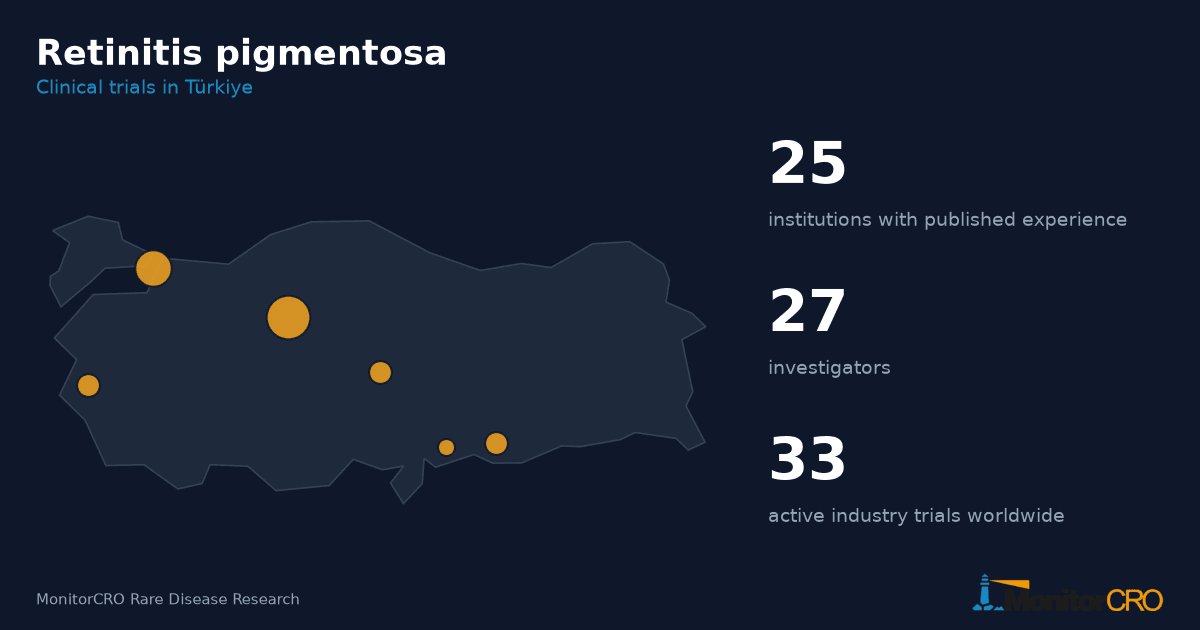
Retinitis pigmentosa (RP) affects an estimated 20,000 people in Türkiye, and the country's consanguinity rate means a larger share of them carry the autosomal recessive genotypes that gene therapy programmes target. Twenty-five institutions in six cities have published on RP or run registered studies, yet none of the 67 industry-sponsored RP trials to date has opened a Turkish site. For a sponsor recruiting genetically defined patients, that is a rare, untouched pool.
Registry and literature data as of 2026-09-24 · Published 2026-10-01
~20,000
estimated patients in Türkiye
22-24%
consanguineous marriages nationwide
25
institutions with published RP experience
0
industry RP trials with a Turkish site
Retinitis pigmentosa at a glance
RP (ORPHA:791) is a group of inherited retinal dystrophies in which rod photoreceptors degenerate first, causing night blindness in childhood or adolescence and progressive loss of peripheral vision. It affects about 1 in 3,500 to 4,000 people in the United States and Europe. Inheritance is autosomal dominant, autosomal recessive or X-linked, and in 40 to 50 percent of non-syndromic cases only one person in the family is affected. More than 80 genes are involved, which is why the pipeline is dominated by gene-specific and gene-agnostic therapies: 41 industry sponsors have run 67 Phase 1 to 3 RP studies, 33 of them active today and 20 started in 2024 or later.
The landscape in Türkiye
Applied to a population of about 85 million, the global rate suggests 21,000 to 24,000 people living with RP in Türkiye. The national demographic surveys have measured consanguineous marriage at 22 to 24 percent of all marriages for decades, and Turkish inherited retinal dystrophy cohorts published in 2025 and 2026 confirm what that implies: a high proportion of autosomal recessive disease and a broad, partly population-specific variant spectrum. For programmes that recruit by genotype, that raises the yield of every screened patient.
Diagnosis and genetic confirmation are concentrated in the ophthalmology and medical genetics departments of university hospitals. Our screen of PubMed and the trial registries found 25 institutions and 27 investigators publishing on RP since 2016, led by Ankara and İstanbul, with active groups in Kayseri, İzmir, Şanlıurfa and Gaziantep. Next-generation sequencing panels, electroretinography and OCT are available at these centres, and genetic testing is reimbursed when ordered by a medical genetics specialist.
Why Türkiye for the next RP study
Gene and cell therapy trials in RP are small and genotype-limited, so the binding constraint is finding confirmed patients, not building large site networks. Türkiye offers an enriched recessive population, referral concentration through a single national payer and genetics departments that already sequence RP families for publication. Because no industry RP trial has opened a Turkish site, none of those patients has been enrolled elsewhere.
Regulatory handling is also clearer than sponsors often assume. Advanced therapy investigational products follow TİTCK's clinical trial rules with product-specific requirements for import, storage and traceability, reviewed within the same single application as any other trial. Sponsors who have run RP studies in Israel or Eastern Europe will find the site set-up and timelines familiar.
How MonitorCRO opens Türkiye
MonitorCRO has run clinical trials in Türkiye since 1999 and acts as legal representative for international sponsors before TİTCK, so no local entity is needed. We prepare and file the single regulatory and ethics application, contract the centres, handle the import permit for the investigational product and monitor the sites on our own Helios EDC. The names of the RP centres and investigators behind the numbers above are shared during feasibility, with their consent.
Questions sponsors ask
How is genetic confirmation handled before enrolment?
University medical genetics departments run next-generation sequencing panels for inherited retinal dystrophies, and existing reports can be summarised in English for eligibility review. Where a protocol requires a specific assay, samples can be shipped to the sponsor's central laboratory under an export permit that MonitorCRO arranges.
Are the ophthalmology sites equipped for trial-grade imaging and ERG?
The referral centres have OCT, fundus autofluorescence and electroretinography, and several have taken part in registered academic studies. Equipment lists and certification are confirmed centre by centre in the feasibility snapshot.
Can a gene therapy product be imported for a trial in Türkiye?
Yes. Investigational advanced therapy products are imported under a TİTCK permit tied to the approved study, with cold chain and traceability requirements that we document in the submission.
Can Turkish sites be added to a study that is already running?
Yes. Adding Türkiye is a new country application to TİTCK with the current protocol version. MonitorCRO acts as legal representative and runs submission, contracting and import in parallel.
Planning a study in this disease?
Tell us the indication, phase and timeline. We reply within two working days with a first view of centres, patient access and a start-up timeline for Türkiye.
Discuss your studySources
- MedlinePlus Genetics: Retinitis pigmentosa
- Orphanet: Retinitis pigmentosa (ORPHA:791)
- Koc I. Prevalence and sociodemographic correlates of consanguineous marriages in Turkey. J Biosoc Sci 2008
- Koç İ, Eryurt MA. The causal relationship between consanguineous marriages and infant mortality in Turkey. J Biosoc Sci 2017
- Demir Ş et al. Decoding the genetic puzzle of inherited retinal dystrophies: novel insights from a Turkish cohort. Clin Genet 2025
- Demirkol A et al. Clinical characteristics and genetic factors in retinitis pigmentosa: a retrospective analysis of a Turkish patient cohort. Med Sci (Basel) 2026
- MonitorCRO screen of ClinicalTrials.gov (industry Phase 1 to 3) and PubMed (Türkiye affiliations, 2016 onwards), September 2026
MonitorCRO Rare Disease Research